The Shadowing Technique for English: How to Do It Properly
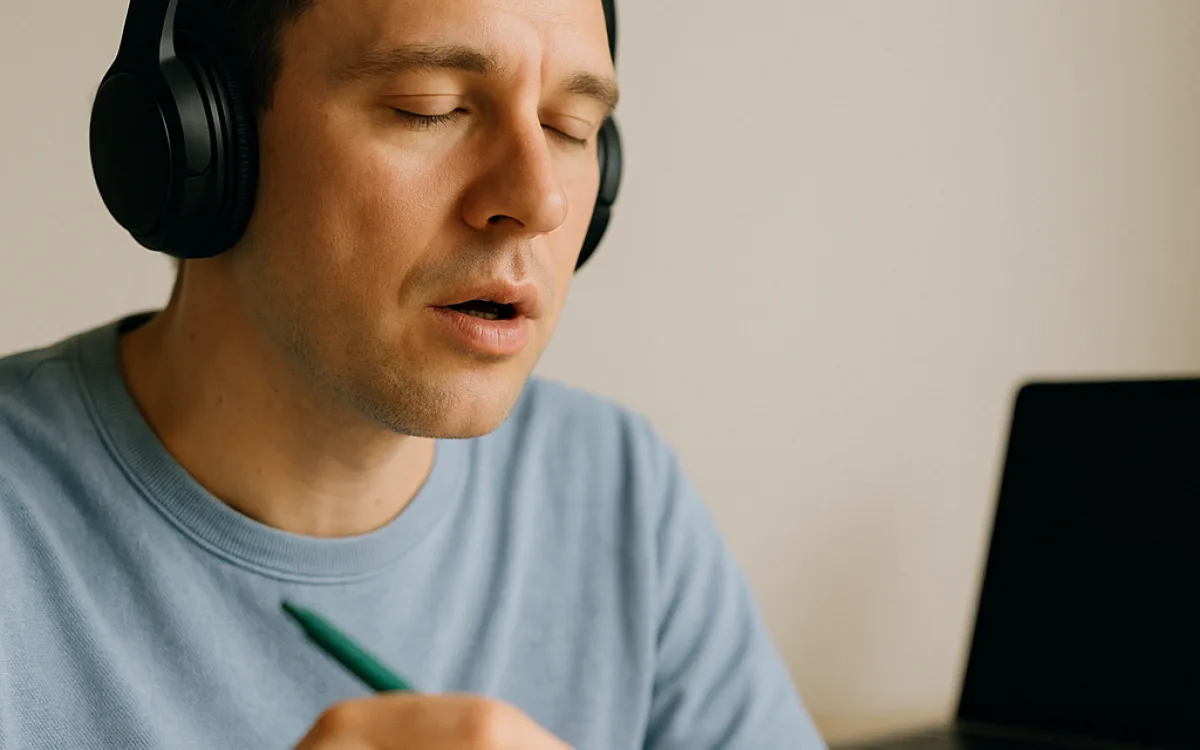
Shadowing means speaking along with a recording, a fraction of a second behind, imitating everything — sounds, rhythm, pauses, even hesitations. It was developed for interpreter training and it remains the single most efficient thing a learner can do alone.
It also fails completely if the material is too hard or the clip is too long, which is how most people meet it and abandon it.
Why shadowing works#
It trains three things simultaneously that are normally trained separately and slowly.
- Rhythm and stress, because you are forced to match the timing rather than impose your own.
- Articulation, because your mouth is making the movements at natural speed rather than careful speed.
- Chunking, because you begin to hold and reproduce phrases whole rather than word by word.
- Listening, because you cannot shadow what you have not accurately heard.
That last point is what makes it efficient. Most exercises train one skill; shadowing trains four because it refuses to let you separate them.
Choosing material#
| Property | What you want | Why |
|---|---|---|
| Length | 20 – 60 seconds | Short enough to repeat ten times without fatigue |
| Difficulty | Slightly below your listening level | You are training production, not comprehension |
| Speaker | One voice, clear, accent you want | Multiple speakers break the rhythm you are matching |
| Transcript | Available | You will need it in stage two, not stage one |
| Content | Ordinary speech, not scripted news | News reading has an artificial rhythm |
Podcast interviews and casual video interviews are ideal. Audiobooks and news bulletins are the two most common wrong choices, because their rhythm is performed rather than natural.
The five stages#
- Listen only. Three times, no speaking. Get the shape of it.
- Listen with the transcript. Mark where the speaker pauses and which words they stress.
- Shadow with the transcript, slowly, allowing yourself to fall behind and catch up.
- Shadow without the transcript. This is the actual exercise; everything before it was preparation.
- Record your shadow and compare it to the original, listening for timing rather than for sounds.
Most people start at stage four on day one, find it impossible, and conclude the technique does not work. It does; it just has a runway.
Common mistakes#
- Material too difficult. If you cannot follow it comfortably at normal speed, you cannot shadow it.
- Clips too long. Sixty seconds repeated ten times beats ten minutes once, by a wide margin.
- Reading rather than shadowing. Once the transcript is in front of you, the eyes take over and the ear stops working.
- Changing material every day. Repetition is the mechanism; novelty defeats it.
- Aiming for accuracy of words rather than accuracy of rhythm. Rhythm is the point.
Use the same clip for a week. It will feel absurd by day three and effortless by day six, and that effortlessness is the transfer you are after.
How much and for how long#
Ten minutes a day for four weeks produces a change most learners can hear in their own recordings. The most visible improvements are in speed and in the reduction of pauses inside phrases — the hesitations move to the natural boundaries where native speakers put them, rather than landing in the middle of a noun phrase.
Shadowing does not build vocabulary or grammar, and it will not teach you what to say. Pair it with free production — describing, self-talk, conversation — or you will get faster at saying a narrow set of things.
Frequently asked questions
What is shadowing in language learning?
Speaking along with an audio recording a fraction of a second behind it, imitating the rhythm, stress and intonation as closely as you can. It was developed for training simultaneous interpreters and is now widely used by language learners because it trains listening, articulation and rhythm at the same time.
How long should I shadow each day?
Ten minutes is plenty, using one clip of twenty to sixty seconds repeated many times. Longer sessions produce fatigue and sloppy imitation, which is worse than not practising. The variable that matters is repetition of the same short clip, not total minutes.
Should I understand every word before shadowing?
You should be able to follow the clip comfortably, but you do not need to have analysed it. If you are stopping to look up words, the material is too hard for this exercise — shadowing trains production, and comprehension work belongs in a separate session.
shadowing technique englishhow to shadow englishenglish shadowing practiceimprove english pronunciation shadowinglanguage shadowing methodenglish fluency exercises